Sunday, November 18, 2012

Book Review - The Gifts of Imperfection by Brene' Brown


Every once in a while you encounter something so unique and special that it stands head and shoulders above the crowd.  That is most definitely the case with Brene' Brown's book The Gifts of Imperfection!  The subtitle of the book says it all:  Let Go of Who You Think You're Supposed to Be and Embrace Who You Are.  I have spent my life smothered by what I perceived as the expectations of others.  So much so that I am, at 62, hard pressed to know who I really am.  And now, at long last, I have someone who gets that and is willing to teach me how to climb out of the trap.

                                                        **   WARNING  **
In the final chapter Brene' warns:  Choosing to live and love with our whole hearts is an act of defiance.  You're going to confuse, piss off and terrify lots of people - including yourself.

I intend to continue with my transformation to living with my whole heart.  If she is right, which I strongly suspect she is, I imagine I will be busy fulfilling her prophecy.  So be it.

That said, I also have expectations of acceptance and encouragement in my quest.  Last evening my wife's family gathered from far and wide on the occasion of the blessing of a new baby in the family.  We gathered at the church cultural hall for pot luck and games and lots and lots of visiting.  Part way through the activities the young girls announced a program they'd put together.  The stage curtains were drawn and we enjoyed dance and drama and song.  After the children had exhausted their repertoire, they invited the audience to participate.  I'd just read Brene's chapter on song, dance and laughter.  While reading it I was jealous of those who can openly express their joy in song and dance and other silliness.  It is a very vulnerable thing to do.  I decided that my time had come to reach inside and resurrect the inner child.  I climbed on stage (not so gracefully) stepped into the wings, and emerging, walked like a chicken across the stage.  The audience called for an encore and I complied with my imitation of an egg beater.  Another round of applause called for my famous fried egg imitation, which rendition I had not done in 30 years!  That was also received with hoots and laughter.

My point?  I had let my need to be cool, suppress all that wonderful joy and personal expression.  For years and years.  One of the things I loved about our visit to Nova Scotia and Newfoundland was the participatory nature of their entertainment.  Everybody sang, everybody danced.  I hope they never lose that.  I hope they never decline to the spectator society the rest of the continent as acquiesced to.

Brown calls the enemy gremlins.  I suspect she does this because most of the shame-based feed back we get, which tends to keep us in our place, is not a maliciously thought out assault, but rather, the effect of an entire culture gone off the beam.  She says:
The gremlins get lots of mileage out of "supposed to" - the battle cry of fitting in, perfectionism, people-pleasing and proving ourselves.....To overcome self-doubt and "supposed to," we have to start owning the messages.  What makes us afraid?  What's on our "supposed to" list?  Who says?  Why?
We get a lot of "supposed to's" in the church.  And some of them make me afraid.  Many of them are not expressed by current fellows in the church but are echos of the lessons and experiences of the past.  Still, friends in my Ward may well expect some "Why's?" and "Who said's" from me.

Now, lest you expect you'll find me more obnoxious as a result of my quest for wholeheartedness; I'll be trying to follow the rest of Brene's advice by seeking to be Courageous, Compassionate and Connected.
By Courageous she means being willing to fully embrace who I am and being brave enough to be that vulnerable.  Obviously, that means my "cool factor" will be in decline.  By Compassionate she means that I must let go of my resentment toward any whom I perceive as trying to shame me back into my old people pleasing, inauthentic ways.  It also means that I must realize that most everyone is just as afraid to be themselves as I am.  By Connected she means that I must seek to develop meaningful relationships along my journey by helping others become authentic as well.

There are Pharisees among us.  I know because I've been one.  I hope I've rooted that out of my system; though I rather doubt that it's entirely gone.  I too am a product of this culture.  The Pharisees like the control their manipulations create and the status that results from it.  They are bound to find me threatening and I'm just going to have to deal with that with all the charity I can muster.  I will most certainly blow it now and again.  This quest for wholehearted authenticity will be, no doubt, a life long journey.  Let it start today!

There are also, wonderful, authentic, exemplary fellow travelers.  One hero was Cheiko Okasaki, who wrote a wonderful book entitled Lighten Up!  I remember her saying in that book:
In principles, great clarity
In practices, great charity
I didn't like that very much when I was a Pharisee.  I'm going to re-read that book next because I strongly suspect that in light of what I've learned from Brene' Brown, Sister Okasaki's book is going to make a whole lot more sense.

Brene' Brown has taught me that:
Wholehearted living is about engaging in our lives from a place of worthiness.  It's about cultivating the courage, compassion and connection to wake up in the morning and think, No matter what gets done and how much is left undone, I am enough.  It's going to bed at night thinking, Yes, I am imperfect and vulnerable and sometimes afraid, but that doesn't change the truth that I am also brave and worthy of love and belonging. 
E. E. Cummings wrote:
To be nobody-but-yourself in a world which is doing its best, night and day, to make you everybody but yourself - means to fight the hardest battle which any human being can fight - and never stop fighting. 
It occurs to me that the late Stephen R. Covey's observation is apropos.  He observed that the chief characteristic of those who reach the Celestial Kingdom is being "valiant in the testimony of Jesus."  He then points out that it is quite possible that that statement refers to Christ's testimony about us as well as referring to our testimony about Him.  His testimony, based on everything He was, said or did, is that we are of infinite worth and divine potential.  We are worthy.  Worthy of love, acceptance, belonging - just as we are.  We may not yet be worthy to attend the temple or enter into Heaven, but we are enough, for now, just the way we are.  In so many ways, Jesus said so.  I pray the day soon comes when our message to one another parallels His.

*****

Saturday, November 10, 2012

Book Review - Daring Greatly by Brene' Brown


Brene' Brown has helped me find a missing piece to a puzzle I've been seeking to solve for a very long time.  I first learned about her work from a TED talk.  And, being inspired by that, sought her books.  This being the first I read.  Brown has done extensive research in to Wholehearted Living and has drawn some fascinating conclusions.  Foremost is strong evidence that wholeheartedness requires the courage to be vulnerable.  Something I hardly suspected.

I was struck by her discussion on the difference between belonging and fitting in.  Here are three definitions she drew from countless interviews:
  • Belonging is being somewhere where you want to be, and they want you.  Fitting in is being somewhere you really want to be, but they don't care one way or the other.
  • Belonging is being accepted for you.  Fitting in is being accepted to being like everyone else.
  • I get to be me if I belong.  I have to be like you to fit in.
Based on those definitions, I don't belong much.  I didn't even belong in my own family as a child.  I had to spend all my efforts fitting in.  I wasn't allowed to be me.  I was expected to be a carbon copy of my Dad; which I was totally incapable to doing.  Much of the time I feel the same way at church, as do most of us I think.  In my High Priests Quorum, for example, we have a lot of great men, who are fitting in, but seem to have no sense of belonging.  Our Quorum is supposed to provide a sense of brotherhood.  I doesn't seem to.  We meet together for three hours every Sunday, but then have little or nothing to do with one another the rest of the week.  Of 20 or so men in that group, I can think of one who has ever been in my home.  Now, I'm not pointing fingers and casting blame, yet.  I'm just making an observation.  

So, what has this got to do with vulnerability and courage?  If Brown is correct, which I believe she is, the blame doesn't lie necessarily with my High Priest's Group, for example; but with me.  In trying to fit in, I am guarded and withdrawn; lacking the courage to present myself as I really am.  Instead, I want to be accepted and culturally have come to the conclusion that they don't want me; only the person I am pretending to be.  According to Brown the responsibility for the fix lies entirely with me.  Now, you can probably see how putting my true self out there might be pretty scary.  That's a pretty vulnerable place to go.  It will require courage.  It might be tempting to remain with the status quo, except; (and here's the rub) we can't really connect at a meaningful level with others if we're are not vulnerably authentic.

I don't think I have to do a lot of persuading to help you realize that connection is one of the things we humans crave the most and often enjoy the least.  Many of  us disconnect out of fear.  Fear of being found lacking in some way.  None of us are perfect, but we get pretty obsessed with presenting ourselves as such in order to fit in.  Certainly it would be nice if those around us from parents and teachers to employers and associates created an environment in which we didn't think vulnerability was so dangerous; but that is often not the case.  That's where courage comes in.  If we really want whole and meaningful connections with those around us, we have to have the courage to present ourselves honestly, despite how vulnerable that makes us feel.  

Fitting in is a hollow substitute for really belonging.  I know from experience.  Still, going for the real deal can be difficult and scary.  Especially, when we have little experience with it and have such an intrinsic fear of rejection.  It is vulnerable to be first to say, "I love you."  One of my favorite literary characters, Chief Inspector Armand Gamache, spends important effort teaching his subordinates to be vulnerable.  He teaches them four things they must always be willing and prepared to say:  I don't know.  I was wrong.  I am sorry.  I need help.  All expressions of vulnerability.  Can you see how they might assist us in making connections with others?  Can you see how their opposites might push others away?  

Part of the fear comes from failing to distinguish between guilt and shame.  For purposes of this discussion:  Guilt means:  I did something bad.  Shame means:  I am bad.  Too often our culture is shame based, both at home and in our institutions.  Shame is destructive.  Guilt is constructive.  If I am shame based, if I see myself as bad, instead of a worthwhile person who's done something bad, I am not likely to be willing to vulnerably present myself in an authentic way.  However, if I feel like I am intrinsically good and have the courage to admit my failings, I am much more likely to improve and to have the help of others in doing it.

Here's a wonderful quote from the book:
"...in an uncertain world, we often feel desperate for absolutes.  It's the human response to fear.  When religious leaders leverage our fear and need for more certainty by extracting vulnerability from spirituality and turning faith into "compliance and consequences," rather than teaching and modeling how to wrestle with the unknown and how to embrace mystery, the entire concept of faith is bankrupt on its own terns.  Faith minus vulnerability equals politics, or worse, extremism,  Spiritual connection and engagement is not built on compliance, it's the product of love, belonging and vulnerability."
That is so true!  I have even thought of changing one of the Primary songs since reading this book.  Perhaps a more accurate lyric would be:  I try to fit in to The Church of Jesus Christ of Latter-day Saints.  It currently says, "I belong.."  Brene' Brown has made it plain that belonging is far more than membership.  One of my daughters, who no longer attends church once told me that if she was treated at church the way she is treated at home, she'd still be attending.  In other words, she's not currently prepared to fit in, but she'd like to feel like she belongs.  Clearly, her church experience, which included ostracism, was shame based.  "You don't belong here."  This has been troubling to me for a long time.  Ostracism is a false and political consequence.  She, like each of us, has been guilty of sin (which always has it's own consequences) but being rejected or pushed away for it is not an appropriate one of them.  (See Elder Dallin H. Oaks' talk, General Conference of The Church of Jesus Christ of Latter-day Saints, October 2012.)  Even though, she may be a cultural victim of less than perfect, yet worthwhile, Latter-day Saints, she remains responsible for the solution.

Well did Jesus admonish us to be "circumcised of heart."  I think by that He meant to be clean, sensitive and vulnerable. Think about it.  Too often, I have been trying to fit in with Him too.  Telling Him what I thought he wanted to hear, instead of vulnerably, honestly presenting myself before Him, just as I am.  I cannot grow from where I ought to be.  Only from where I actually am. He has made it plain that I have value with Him, that I belong and that if I will let Him help me, He will.  To Him I must also be willing to say:  I don't know.  I was wrong.  I am sorry.  I need help.


Book Review - Bury Your Dead by Louise Penny


I've been re-reading the entire Chief Inspector Gamache mystery series in anticipation of the eighth novel.  Updating my recollection is only part of the motivation though.  I don't ordinarily re-read much fiction.  I've found Louise Penny's work to be too important for a single run through.  Her novels teach me so much about myself, my flaws and vulnerabilities as well as my strengths, opportunities and potential for joy.  I am certain to read them all a third and fourth time and fully expect to glean more strength, wisdom and insight with each visit.

Some classify Penny's books as cozy mysteries.  They are quite cozy and can certainly be enjoyed as such, but for the contemplative seeker; they can be so very much more.  

This seventh novel is about frailty, about making and living with mistakes.  About living with or even in, the past.  Set in Quebec City, one of my very favorite places, the novel explores the city's past while Gamache and a few other characters explore their own.
     "I sometimes think we're a rowboat society."
     "A what?" asked Jean.
     "A rowboat.  It's why we do that."  He jerked his head toward the window and the dot on the river.  (Someone in a canoe crossing the icy St. Lawrence in a re-enactment race.)  "It's why Quebec is so perfectly preserved.  It's why we're all so fascinated with history.  We're in a rowboat.  We move forward, but we're always looking back."

For them, the past was as alive as the present.  And while forgetting the past might condemn people to repeat it, remembering it too vividly condemned them to never leave.  He was a man who remembered, vividly. 

It happens in societies and it happens with individuals as well.  This story is really three stories in one. Three stories which are so expertly woven together to express the underlying theme as to be utterly astonishing!  Penny's work gets more compelling and amazing with each book.  Gamache makes the perfect hero by being imperfect; by showing us how to deal with our own imperfection.  And by contrasting that with those who are unable to.

     To be silent in hopes of not offending, in hopes of being accepted.
     But what happened to people who never spoke, never raised their voices?  Kept everything inside?
     Gamache knew what happened.  Everything they swallowed, every word, thought, feeling rattled around inside, hollowing the person out.  And into that chasm they stuffed their words, their rage.

      Why was he still investigating the Renaud case?  Was this his private misdirection?  Was he trying to take his mind off something he might otherwise have to see?  And hear? and Feel? Was his whole career like that?  Replacing one ghost with a fresher one?  Racing one step ahead of his memory?

     That was the danger.  Not that betrayals happened, not that cruel things happened, but that they could outweigh all the good.  That we could forget the good and only  remember the bad.

And so we remember.  It is not so much that we remember; but what we choose to remember, and how.

Je me souviens. 

*****

Book Review - The Brutal Telling by Louise Penny


Number five in the Chief Inspector Gamache mystery series, The Brutal Telling keeps me captivated!

This one's a story of fear and greed, best explained by a couple of quotes:
     "The Hungry Ghost," said Gilbert.
That roused Gamache, who twisted in his garden chair to look at the dignified man next to him.
     "Pardon?"
     "It's a Buddhist belief.  One of the states of man from the Wheel of Life.  The more you eat the hungrier you get.  It's considered the very worst of lives.  Trying to fill a hole that only gets deeper.  Fill it with food or money or power.  With the admiration of others.  Whatever."
     "The Hungry Ghost," said Gamache.  "How horrible."
     "You have no idea." said Gilbert.

 Gilbert glared at him.  His rage back in full force.  But Armand Gamache knew what was behind that rage.  What was behind all rage.
    Fear.

Fear is also behind the lies we tell and this story is full of them.  The interesting part is that it is not just the murderer who cannot tell the truth.  So many others for greed and fear cannot come up with the truth.  And since Chief Inspector Gamache is all about finding the truth and exploring the deep dark places where it too often hides, we get an exciting, interesting, stunning peek to some pretty frightening places that may not be all that unfamiliar.

And what a tale those eyes told Gamache.  In them he saw the infant, the boy, the young man, afraid.  Never certain what he would find in his father.  Would he be loving and kind and warm today?  Or would he sizzle the skin off his son?  With a look, a word.  Leaving the boy naked and ashamed.  Knowing himself to be weak and needy, stupid and selfish.  So that the boy grew an outer hull to withstand assault.  But while those skins saved tender young souls, Gamache knew, they soon stopped protecting and became the problem.  Because while the hard outer shell kept the hurt at bay, it also kept out the light.  And inside the frightened little soul became something else entirely, nurtured only in darkness.

I have been exploring honesty and authenticity a lot lately and The Brutal Telling has been a classic case study that has helped me greatly in my own quest to understand and break out of my own protective, stifling shell of fear.

*****


Monday, September 3, 2012

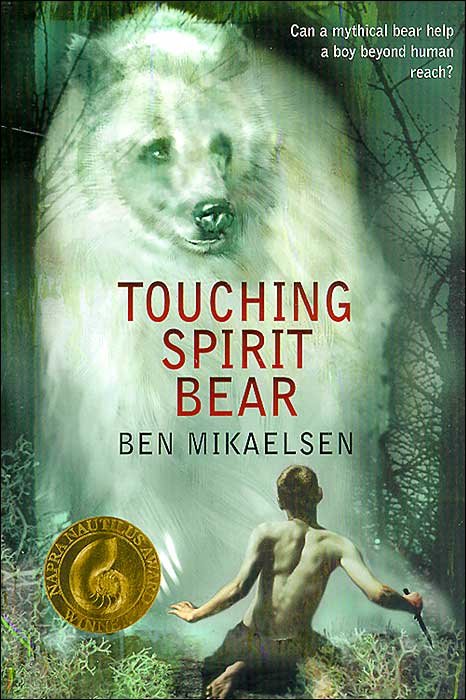
Book Review - Touching Spirit Bear by Ben Mikaelsen


I have been involved in helping youth at the local juvenile detention center for over eight years now.  I have spent a lot of time wondering about the best ways to approach the problems these wonderful youth face.  How can we help them?  How can we assist them to find solutions and healing?  What are the best resources for facilitating this progress?

I also spent several months living in the wilderness with troubled youth.  I despised the model that program used.  While "the mountain" had its healing powers, because it was far away from drugs and influences, completely distant from privileges and possessions; it could have been so much more.  This wilderness program made the mountain merely a tool for isolation.  They could have done that in a warehouse.  In Touching Spirit Bear, the wilderness, in this case the island, was so very much more.  That "more" was what was entirely lacking in the wilderness program and is hardly even sought in our current judicial system.

Ben Mikaelsen's book provided many of the answers I've been seeking.  There is wisdom here and great risk.  I think we will never see this kind of method commonly used because of the risk.  We don't take those kinds of chances with our youth and the consequence is, we don't get this kind of results.  I think life in general was designed by God to be just this risky, but lawyers and hand wringers have taken much of the potential out of life and consequently out of the lives of our youth.

Reality therapy is pretty simple, as one character, Garvey, tell his young friend Cole:
"Go ahead and try it.  Try manipulating a storm or lying to your hunger.  Try cheating the cold."
There is more to the process this book reveals.  It is not only about being exposed to reality.  It is also about being, exposed to love.  This is another ingredient that seems quite lacking in the institutional setting.  The powers that be, in an honest effort to protect, have even sheltered these kids from love.  Human contact is prohibited.  Perhaps that's risky too. This is not to say that the staff at these institutions lacks love for their charges.  Quite to the contrary, most are under paid and under appreciated and stay precisely because they love these kids.  But at the end of the day, if because of societal fears and institutional rules, these kids don't experience individually focused love, don't connect with others who deeply care about them, don't feel healthy, safe human contact, they won't be getting better and we'll continue to see many of them behind bars again and again.

So I hammer on about the details, while Mikaelsen just tells a story.  And what a wonderful, heart rending, uplifting and inspiring story it is.  Some kids will get the message vicariously through the story.  I did.  You see, I'm not appreciably healthier than they are.  It is clear though, that Cole's experience living it will be infinitely deeper than my experience reading about it.  And Cole's recovery will be correspondingly sturdier than mine has been.  As I note this, though, I realize that reality and love can be had right here where I am.  I don't have to isolate myself to an island or a mountain.  Reality and love are everywhere. The difference is that here I have access to the tools I use to avoid them.

*****


Book Review - Odd Apocalypse by Dean Koontz


Two Odd books in a row!  I am indeed working on my ODD.  My appreciation for Odd Thomas grows and grows.  I love his simple, unassuming ways.  I thrill at his optimism and at his thought provoking philosophical approach to life.  While my imagination falls far short of Dean Koontz's there is a familiarity and  and brotherhood that warms me every time I read his work.

Here are a few philosophical gems:
"Without faith to act as a governor, the human mind is a runaway worry generator, a dynamo of negative expectations.  And because your life is yours to shape as you wish with free will, if you entertain too much anxiety about too many things, if you place no trust in providence, what you fear will more often come to pass.  We make so many of our own troubles, from mere mishaps to disasters, by dwelling on the possibility of them until the possible become inevitable."
"Narcissists are everywhere in this ripe age of self-love, which amazes me because so much in life would seem to foster humility." 
"Knowing the names of things is a way of paying respect to the beauty of the world that sustains me and keeps my sorrow in check."
"I have witnessed others demonstrating by their addictions that chemically induced euphoria is subject to something quite like the law of gravity:  What goes up must eventually come crashing down." 
"You can't stand an idea up against a wall and execute it.  Neither can you wrap in up in a tissue of your better judgement and tuck it in a box of forgetfulness.  An idea can be the most dangerous of all things, especially if it is an idea that promises you the most paticular and exquisite happiness for which you've long yearned." 
"Maybe it's just that before anything came the word, and words are the roots of everything that our senses perceive.  Nothing can be imagined, nothing can be visualized in our minds, until we have a word for it.  Therefore, when I give myself to the free flow of any words that trip off my tongue without predetermination, I am tapping in to the primal creative power at the heart of the cosmos." 
"But if there can be a change for the worse, there can be a change for the better." 
"The best part of a Mr. Goodbar is not the wrapper, is it?  No, and the best part of a Coke is not the can.  On those nights when you lie awake, either man or boy, wondering about yourself, peeling away one layer of oddness after another, you should remember and always be grateful that the woefully imperfect person that you are, with all your contradictions and unworthy desires, is not the best of you any more than the wrapper is the best part of a Mr. Goodbar." 
And the story is interesting and a lot of fun too!

The second biggest thrill from reading this book is the promise, which comes at the end, of yet another book in the Odd Thomas series, Deeply Odd.  Can't wait!

*****

Thursday, August 23, 2012

Book Review - Odditude by John R. Powers


The sub-title of this little volume says it all:  Finding the Passion for Who You Are and What You Do.

This is a great bathroom book.  Each chapter is short succinct and wonderfully clear about what one might to to enhance one's uniqueness.  In a world that increasingly seeks to homogenize the population.  Dr. Powers makes a strong argument for maintaining and developing our own individuality, our ODD.  ODD is where happiness, growth, excitement and opportunity are found. 

I loved the book and intend to spend time reviewing it often.  I hope to establish my ODD and to foster the ODD in those around me.  I have seen raw milk that was 75% cream.  All of the cream rose to the top.  Surely some became butter, some was poured over peaches, some was frozen into ice cream and some, whipped, topped a wonderful pie.  The point is, it rose above the ordinary, because it wasn't homogenized.and made EVEN with the milk.  There is ODD in each of us and fostered will make each of us better and consequently, the world will be a better place.

No doubt we'll get resistance from those who'd make us EVEN, but the effort and consequent persecution will be worth it.

I highly recommend this one.  Share it with your kids; unless you're a parent who'd rather make them EVEN because you're a control freak.  In that case, I'll share it with them.  :-)

*****


Saturday, June 30, 2012

Book Review - The Healing Code by Alex Loyd and Ben Johnson


This one came highly recommended so I dived into it with earnest intent.  I loved it...that is until I got to the actual code.  Then I got pretty squeamish about the whole thing.  The idea of the book is that all of our maladies, be they physical or emotional, are the direct result of stress.  By stress they mean something deeper more non-nondescript that the pressure of deadlines and rush hour traffic. Loyd and Johnson conclude that this deep "cellular" stress shuts off our immune system or at least slows it down.  So, the key to health is in figuring out a way to fire the immune system back up.  I buy that.

The authors explain in depth that our memories are stored at the cellular level and throughout our entire bodies.  The brain is just the central processor.  I can also buy into this.  We once had a Shetland Sheep dog we raise from a pup.  His name was Pepper.  His mother had given birth to him in an urban apartment and we took him home to live in a city house and it's back yard.  He had most certainly never seen a sheep.  One day when he was about 9 or 10 months old we took a family drive on the mountain.  Pepper was in the back seat with the kids.  We were driving slowly through the mountain woods on a dirt road.  The windows were open and we were enjoying the cool mountain air.  Rounding a bend we encountered a grazing herd of sheep in a pretty meadow.  When Pepper saw the sheep he bolted out the window, sprinted into the herd, cut out about six head of sheep and separated them from the rest.  We apologized to the sheep herder as we called the dog back to the car.  He didn't want an apology; he wanted the dog!  Pepper had never laid eyes on a sheep but encoded in his DNA was all the memory he needed to know exactly what he was bred for and how and what to do with that knowledge.  It was astounding to say the least.  If that much memory can be stored in a dog's DNA, it isn't much of a leap to think the same and more could happen for us.

So, Loyd and Johnson make a case for the possibility that lies, fears and misperceptions are stored in us at the cellular level and that this "programming" not only controls us subconsciously, but causes us unhealthy stress.  I'm quite comfortable with all this.

Their solution though, is another matter.  They are Christians and include prayer as part of the process, but they also include some rather hocus pocus Chakra type energy alignment type stuff that gives me pause.  I can't quite see how "shining" my finger tips on my Adam's apple while thinking good thoughts is going to reprogram my cellular memory.  On the other hand, I suppose it couldn't hurt, so I've been taking it for a spin.  They have case studies of instant results after just one "shining."  Not so with me.  But, as I am not a quitter and am trying to be open minded instead of empty headed, I think its only fair to give it a good serious try before making my final assessment.  So, when I'm satisfied, one way or the other, I'll come back and let you know what I think.

Tuesday, June 26, 2012

Book Review - The Overton Window by Glenn Beck


I've reviewed a number to Glenn Beck books lately.  This is interesting because I have never tuned in to his television or internet programs.  I've watched a portion of two on YouTube and that's about it.  I was given every book but one as gifts from conservative friends and family members.  I am not "conservative" nor "liberal", nor "progressive" though I have views that would fall under each label.  I believe in moderation in all things, though I'd hardly call myself a "moderate" either.  I guess that's my problem, the divisive nature of politics these days, the us versus them ideologies, of necessity, leaves me out.  I don't like labels and I'm not about to label myself when plenty of people are eager to do that for me.  I'd like to join the McGillicuddy Serious Party, but it is either defunct or (in my dreams) gone underground. 

That said, again, I've found a book of Beck's that is well worth the time I spent reading it.  This one, a novel, is an absolute page turner.  It is just plain fun to read, with a good deal of human warmth and interest.  The Overton Window refers to an imaginary frame within which is pictured the spectrum of what the public will tolerate.  The idea is that there are forces at work to nudge that window toward a greater toleration of tyranny.  It is not such a hard concept to accept.  We see, all around us, ample evidence that the window has moved to the left and plenty of evidence that it will continue in that direction.  The beauty of the story lies in the amazing light the book sheds on why this is being done and who is doing it.

As I said before, this is a novel, a work of fiction.  As such it is a fun, thrilling ride through intrigue, danger and personal triumph.  But, it is not fantasy.  There is a ring of truth, possibility and even probability that resonates strongly through the book.  Being a Mormon and believing The Book of Mormon, I have little doubt that there are secretive groups abroad whose motivations are greed and power and whose methods are evil and nefarious. For me, The Book of Mormon purposefully prophesies of such "secret combinations" as a warning to us of the perils of our times.  After all, it was written for us and is plainly meant to be pertinent here and now.  Beck has made such conspiracy about as realistic and credible as ever I've seen.

I hope you'll read it.  For me, it nudged the "Overton Window" back to the right by quite a bit.  I'd like to see such a movement in the overall mindset of America.  You see, it can't move the wrong way (away from freedom) unless we let it, tolerate it.  Unless we believe the lies being carefully, gradually fed to us.  Unless we accept the fear being spoon fed to us by those who first want to "protect us," then own us.  I was quite surprised by the who and how of the enemy's methods, not so much, by the why or where or when.  I'm so very glad to have a clearer idea of what we're up against.

*****


Friday, June 15, 2012

Book Review - Healthy Shame: How To Spank Your Inner Monkey! by Joseph W. Dopp


I've learned that Shame is a fundamental cause of addiction.  Shame as opposed to guilt.  The definition I accept is:  Guilt - I did wrong.  Shame - I am wrong.  Clearly shame is damaging as is presupposes that I am fundamentally flawed rather than being a person of divine potential who has made mistakes.  Even terrible mistakes.  So this title held a bit of intrigue for me and I decided to give it a try.  I didn't get very far.  While Dopp is witty, I didn't find him to be all that funny, which he was clearly shooting for.  Instead I found him irreverent and crass.  Even that I endured until he explained that a fundamental principle of his method decried what he called the prideful notion that we might ever become like God.

I believe God is my own Father and that His greatest desire is for His offspring, me and you, to grow to become like Him.  Dopp says we are clay in God's jar.  I declare that we are not clay in Gods jar, nor are we pawns on His chess board, nor sheep in His pasture nor art in His Gallery.  We are not rats in His laboratory we are His own sons and daughters, endowed with divine potentiality.  Dopp sees my position as blasphemous.  He can think as he wishes.  I however, couldn't find enough common ground in our philosophical approaches to change to warrant finishing the book.  Our views are built on entirely different foundations.

Book Review - Questing for Uberjoy by Konrad Ventana


Sweetie was given this book to review and passed it on to me.  It is available for purchase so it isn't an advanced reader copy.  I took it because of the cover picture.  It intrigued me as I've had a fondness and curiosity for the Orient ever since is lived for two years in the Philippines and visited Hong Kong, Taiwan and Japan on my way home.

Konrad Ventana is enigmatic for me.  He is obviously brilliant.  The book reads like Young Adult Fiction as the story line breezes right along.  Yet it contains a depth and maturity that is truly surprising.  Ventana's vocabulary would put Alex Trebek to shame.  At first I set to using a dictionary; and needed one in almost every sentence.  That being too tedious, though, I began extrapolating the meaning of the myriad words unfamiliar to me and just settled in and enjoyed the story, and the philosophy, and the travelogue and the anthropology of Nepal.

At first I thought the elaborate vocabulary to be ridiculous; but came to love the concise, compact, brisk style the accurate use of words can offer.  Ventana is anything but verbose.  His economic expenditure of rich language is amazing!  Equally impressive is his geographic understanding of Nepal and Tibet and his cultural and religious savy of Eastern ways.  Now, I'm no expert in these things, so he might have pulled the wool over my eyes; but I take Konrad Ventana at face value and easily assume him to be as truly brilliant intellectually as his prose makes out.

Now, I won't spoil the story for you.  Suffice it to say it is an exciting page turner that moves right along to a very surprising conclusion.

I read to learn about myself and this little tome really did the trick.  Orion the main character is obviously on an important quest.  Towards its conclusion he begins to worry about where to go next.  A problem I'm currently grappling with.  All along the journey he has had a native companion who has been both his physical and spiritual guide.  Orion wants Segunda to continue on with him - to help him determine his next destination so to speak.  He begs for this and his companion replies:
"Segunda has no answers of such originality for you." he said.  "As you might recall, Segunda was recruited to be your guide only when your path was firmly established and your course of action was already indelibly clear...  However, you should know this:  When you set out to right some wrong that needs to righted, but has not been righted yet...when you endeavor to overcome some evil that by all standards of human decency need to be defeated, but has not been defeated yet... when you set about the task of fashioning some marvelous elixir for the body or the mind that should by all measures of human value be celebrated from a place beyond the highest rooftops, and yet the voices of all the earthly authorities remain only silent or shrill ... you may again find a Segunda, to second your own emotions and to guide you on your way."
More simply put, "When the student is ready the teacher will come."  To a large degree Konrad Ventana was such a teacher for me...for which I am grateful.

Personal Note:  My latest Segunda goes by the name of Darwin.  Thanks Darwin.

So I've learned that my next quest must be found within me and that is where I shall seek.  I liked this volume enough to be certain to read the first two in the Trilogy: A Desperado's Daily Bread and The Unbearable Sadness of Zilch.  Each one appears to stand alone, so I hope being out of sequence hasn't hurt.

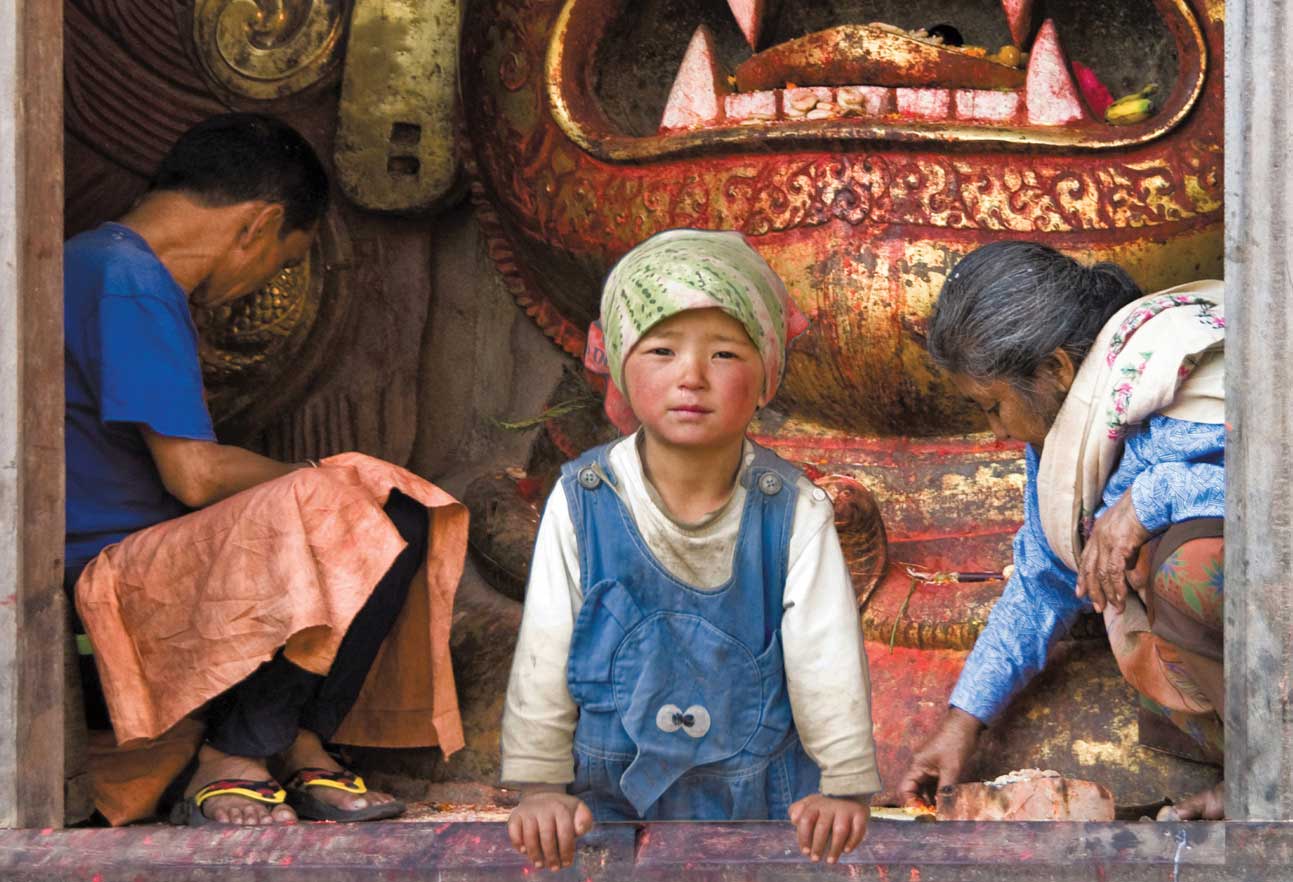
The cover illustration depicts a little Nepalese girl who has captured my attention.  She is not mentioned specifically in the book, but I cannot refrain from gazing into her face.  She seems to be speaking directly to me and somehow I can divine that she is asking me, "So, what's it gonna be?"  I feel compelled to answer her question.


****


Book Review - The Cellist of Sarajevo by Steven Galloway


This wonderful little work of historical fiction sat, neglected, on my bookshelf far too long.  I'm so glad I finally got round to reading it.

I fondly remember when Sarajevo hosted the Winter Olympics.  It was fun to get a peek into this wonderful, old and cultured city.  I imagined I'd like to visit there.  Since then, of course, much of the grand old place has been destroyed by war.  During the Siege of Sarajevo a bomb fell into a street and killed 22 people who were waiting in line for bread.  For the next 22 days, Vase Miskina climbed onto the rubble with his Cello and played Albinoni's Adagio in G Minor, once for each of the fallen citizens who died in the bread line.  This is the historical fact.  The rest, though fiction, reminds us of the strength of the human spirit as three primary characters, not Vase Miskina, go about their lives amid the chaos of war.

This is not a political book.  There are no references to race, religion, or particular prejudice; though those things surely played a part.  There is no justification or rationalization for the position of either side of the conflict, no attempts to persuade the reader to choose sides; though we clearly become sympathetic with the Sarajevan Citizens whose lives we follow.  This is a book about resilience, confusion, persistence, endurance, despair, hunger, corruption and the down right ridiculousness of war.  It is about the power of music and the effect of courage.  It is about the randomness of victimhood and the comfort of routine amid chaos.  It is about the learning of life's lessons in the harshest of laboratories and the quiet goodness of humankind.

Some other book may explore the minds and hearts of the aggressors; "the men in the hills;" not this one.
Perhaps they are no different than the defenders trapped in the city.  Who knows.  Some other book may explore the corrupt and opportunistic advantage-takers among the citizens of Sarajevo itself; not this one.
This one quietly places you and me in the middle of the chaos and helps us see how very good and resolute and courageous we might be as we range far and wide in search of water and bread and companionship and peace.  This book examines how we might be when our surroundings are reduced to rubble and survival becomes each day's luxury.

This morning I walked along a roadside in Rawlins, Wyoming.  The borrow pit was dry with brittle weeds and littered with trash.  Amid the withered grass and weeds stood one single bright Brown Eyed Susan blossom.  It's verdant beauty stood in stark contrast to it's surroundings.  Again, I thought of the singular precious human beings that stood as quiet reminders amid the rubble of Sarajevo.  A man, a woman, a girl, a cellist, who even in the harshest of environs, bloomed.

*****

Thursday, June 14, 2012

Book Review - Will Power Is Not Enough by A Dean Byrd and Mark D. Chamberlain


I hold that Jesus Christ is the author of change.  So, it seems, do Byrd and Chamberlain.  While that simple statement is profoundly true, there are some things we each must understand in order to tap into the power of change.  This little book has been tremendous in helping me effect change in my own life.

Here are a few notions from the book that seemed especially helpful to me:
"Problems of self-control are often misguided attempts to meet legitimate needs."
"The difference between "want to" and "should" is a profound one."
"Whether we are trying to abstain from alcohol, drugs, binge eating or gambling, most failed attempts can be traced back to some unexpected emotional stress."
"When it comes to changing our lives, our energy is often better spent in setting the sail than in rowing the boat." 
These all ring very true to me.  I found it motivating to better understand the situation I was really in before I tried to make adjustments to my behavior.  Often, I can find healthier ways to meet my emotional needs, which when met, cease to compel me to meet them in unhealthy ways.

The book is replete with case studies, which both illustrate the principles being described and also to help the reader realize the nature of their own self defeating behaviors.  It is one I will definitely re-read.

Perhaps the most telling part of the book for me, was the realization, from a case study, that the lion's share of my problem lies, not in misbehavior, but in being stuck in the middle of the bridge between the things I want.  On one end of the bridge are unhealthy means for meeting my emotional and spiritual needs.  On the other end are the good things I desire.  When I fail to understand what needs I hope to meet I fail to identify the uplifting ways God has designed to meet those needs.  I don't want to do the bad behaviors, but don't recognize their authentic alternative, so resisting the bad I'm like a dog stuck in the middle of the bridge with his loved master calling from one end and some appealing smell on the other.  I shudder to think of the hours and hours I've wasted in my life, not doing bad, just stuck in the middle of the bridge doing nothing.

*****
Related Posts Plugin for WordPress, Blogger...